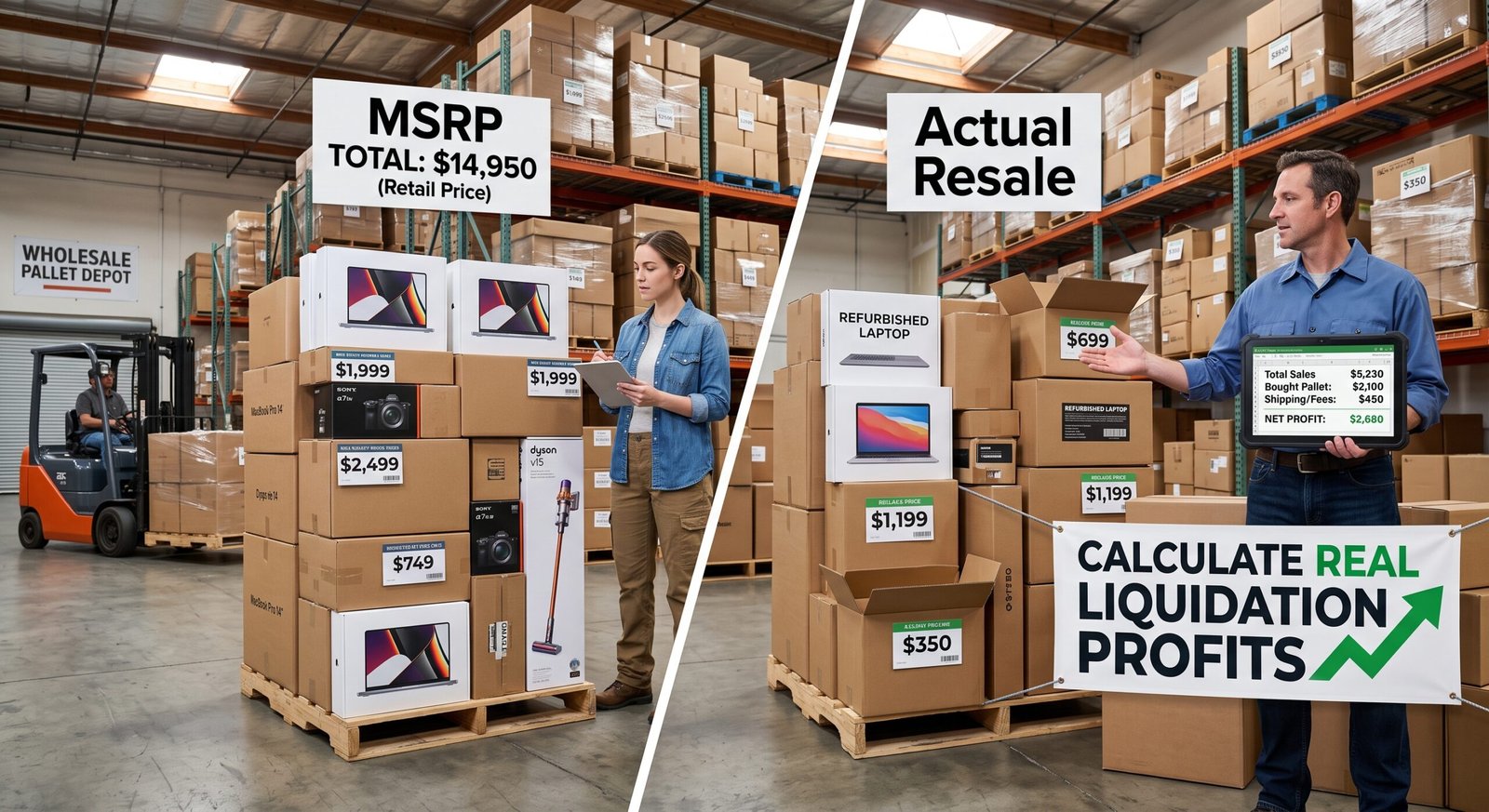
Here’s the single most expensive mistake a new liquidation buyer makes: treating the total retail value on a manifest as money already sitting in their pocket. A manifest listing $5,000 in liquidation pallet MSRP is not a $5,000 pallet, and confusing the two is exactly how beginners end up paying far more than a load is actually worth.
This guide walks through the real math. How much of that stated MSRP you can actually expect to recover, how to calculate a genuine maximum bid before you buy, and a worked example showing exactly how the numbers play out from manifest to final profit.
Liquidation Pallet MSRP — What That Number Actually Represents
Liquidation Pallet MSRP — It’s the Original Price, Not a Promise
MSRP stands for Manufacturer’s Suggested Retail Price. The original price tag an item carried when it was new, in a store, with full retail markup attached. On a liquidation manifest, this number gets summed across every line item to produce an eye-catching total, but it tells you almost nothing about what you’ll actually collect once you resell that inventory. A three-year-old electronics item might carry a $199 MSRP on paper while its actual current resale value on eBay or Amazon sits closer to $40, simply because the market price for that product has moved on since it launched.
Liquidation Pallet MSRP — Why Suppliers Lead With This Number Anyway
To be fair, this isn’t always deceptive. MSRP is a standard, industry-wide way to describe a manifest’s contents, and reputable suppliers use it because there isn’t a simpler universal alternative. The responsibility shifts to you as the buyer to translate that number into something realistic, rather than trusting it as a direct measure of what the pallet is worth.
Actual Resale Value Liquidation — Realistic Recovery Rates by Category
Actual Resale Value Liquidation — What the Data Actually Shows
Multiple independent sources in the liquidation industry converge on a similar pattern once you look past the marketing: actual resale value liquidation typically lands somewhere between 20 and 45 percent of stated MSRP, with the exact figure depending heavily on category and condition grade.
| Category | Realistic Recovery Rate (% of MSRP) |
|---|---|
| Consumer electronics | 25% – 40% |
| Power tools and hardware | 30% – 45% |
| General merchandise | 30% – 40% |
| Apparel and soft goods | 20% – 35% |
| Appliances | 25% – 40% |
These ranges assume customer returns or mixed-condition inventory. Genuinely new, shelf-pull, or overstock inventory tends to sit toward the higher end of each range, while unsorted or salvage-grade loads tend to land toward the lower end.
Actual Resale Value Liquidation — Why Electronics Recover Less Than You’d Expect
Electronics consistently sit toward the lower end of realistic recovery ranges, and it’s worth understanding why. High return rates in this category often come with missing cables or accessories, locked accounts that need to be cleared before resale, or components that test as dead on arrival. Even when a manifest lists an accurate MSRP, the practical hassle and failure rate specific to electronics pulls actual recovered value down further than a category like power tools, which tend to be more durable and easier to verify as functional.
MSRP vs Resale Liquidation Pallets — The Manifest Verification Method
MSRP vs Resale Liquidation Pallets — Checking Sold Listings, Not Asking Prices
The single most useful habit you can build before bidding on any pallet is checking real sold prices, not active listing prices, for the highest-value items on the manifest. Active “asking” prices on marketplaces are frequently aspirational and don’t reflect what buyers are actually paying. eBay’s sold listings filter lets you see actual completed sale prices for a specific item, which is the number that matters for your calculation.
Pull the ten to twenty highest-value line items from the manifest, search each one specifically in eBay’s sold and completed listings, and compare the real sold price against the manifest’s stated MSRP for that item. If your sample consistently comes in below 30 percent of stated MSRP, that’s a strong signal the entire manifest is overstating value, and you should adjust your maximum bid downward accordingly, or walk away from the lot entirely.
MSRP vs Resale Liquidation Pallets — A Quick Real-World Illustration
Say a manifest lists a wireless earbud case at $89.99 MSRP. A quick check of sold listings on eBay shows the same model, in similar condition, actually selling for $24 to $32. That’s roughly 30 percent of stated MSRP — right at the edge of viable, and a useful data point to weight the rest of your calculation around rather than trusting the manifest’s headline number.
Liquidation Pallet Valuation — A Simple Formula You Can Actually Use
Liquidation Pallet Valuation — The Core Calculation
Once you’ve verified realistic recovery rates for the categories in your manifest, the actual liquidation pallet valuation formula is straightforward:
Net Resale Value = (Total MSRP × Category Recovery Rate) − Freight − Platform Fees − Processing Time Cost
From there, a commonly used guideline is to cap your maximum bid or purchase price at roughly 30 to 40 percent of that net resale figure, preserving enough margin to absorb the inevitable items that don’t sell at all.
How to Calculate Liquidation Profits — A Worked Example
Let’s walk through a realistic scenario from start to finish. Say you’re evaluating a general merchandise pallet with a manifest listing $4,000 in total MSRP across 60 items, condition graded as mixed customer returns.
Step 1 — Apply a realistic recovery rate. General merchandise mixed returns typically recover 30 to 40 percent of MSRP. Using a conservative 32 percent: $4,000 × 0.32 = $1,280 estimated gross resale value.
Step 2 — Subtract freight. A standard pallet shipped within the continental US commonly runs $200 to $300. Using $250: $1,280 − $250 = $1,030.
Step 3 — Subtract platform fees. Assuming a blended 15 percent across your resale channels: $1,030 × 0.85 = $875.50 net resale value.
Step 4 — Calculate your maximum bid. Capping your purchase price at 35 percent of net resale value: $875.50 × 0.35 = roughly $306 as your maximum reasonable purchase price for this specific pallet.
If the pallet is priced at $600, walking away is the right call — the math simply doesn’t support that price once you’ve replaced the manifest’s MSRP fantasy with a realistic recovery estimate. If it’s priced at $280, you have a genuinely viable purchase with real margin built in to absorb items that don’t sell.
How to Calculate Liquidation Profits — Common Mistakes to Avoid
Treating MSRP as your revenue ceiling instead of your starting point. The manifest total is where your calculation begins, not where it ends.
Skipping the sold-listings check on high-value items. This single step takes twenty to thirty minutes and consistently prevents the most expensive buying mistakes.
Forgetting processing time has real cost. Sorting, testing, cleaning, and listing inventory takes genuine hours. Even if you don’t pay yourself an hourly wage directly, undervaluing this time leads to an inflated sense of profitability that doesn’t hold up over repeated purchases.
Averaging instead of flagging high-value outliers separately. A single expensive item with an inflated MSRP can distort your entire manifest total. Check high-value line items individually rather than assuming the whole list follows the same recovery pattern.
For general pricing and listing strategy once you’ve calculated real value, our guide on pricing liquidation items to sell fast and our breakdown of liquidation pallet grades explained are both useful companion reads.
Actual Resale Value Liquidation — Why This Math Matters More as You Scale
A single miscalculated pallet is a manageable, if frustrating, lesson. The real cost of skipping this kind of liquidation pallet valuation shows up once you’re buying regularly. A buyer who consistently overpays by even 15 to 20 percent above realistic value, purchase after purchase, is quietly eroding their entire business model without necessarily noticing it in any single transaction. Because liquidation reselling often involves processing multiple pallets a month once a buyer scales up, small valuation errors compound quickly into a genuinely unprofitable operation that can look, on the surface, like it’s simply “a tough category” rather than a fixable math problem.
This is exactly why experienced resellers treat manifest verification as a non-negotiable step rather than an optional extra, the same way a retail buyer would never commit to a wholesale purchase order without checking real market comps first. Building this habit early, even when it feels like it slows you down on your first few purchases, pays for itself many times over as your buying volume increases. Our guide on how to buy liquidation pallets without losing money covers additional angles on this same core discipline.
How to Calculate Liquidation Profits — Building a Simple Tracking Habit
Beyond calculating profit on a single pallet, keep a running record of your estimated recovery rate versus your actual result once inventory sells through completely. Over time, this personal data becomes more valuable than any generic industry range, since it reflects your specific resale channels, your local market, and your own processing efficiency. A reseller who tracks this consistently can eventually calculate how to calculate liquidation profits with far more precision than someone relying purely on general category averages, because they’re working from their own proven track record rather than an industry-wide estimate.
Liquidation Pallets for Sale — Buy From a Supplier Who Grades Honestly
Accurate valuation only works if the condition grading behind it is honest in the first place. At Wholesale Pallet Depot, our liquidation pallets for sale come with clear, honest condition information rather than inflated retail value claims, giving you a real foundation to run this kind of calculation on. Browse our full Customer Returns category for current inventory, or reach out through our contact page with questions about a specific listing’s manifest.
According to the National Retail Federation, retail returns represent hundreds of billions of dollars in merchandise annually a genuinely large, real market, which is exactly why running your own honest numbers matters more than chasing whatever total sits at the bottom of a manifest.
👉 Browse all liquidation pallets for sale at wholesalepalletdepot.shop
FAQs About Liquidation Pallet MSRP and Resale Value
Is the MSRP on a liquidation manifest accurate?
The MSRP figures themselves are usually accurate as original retail prices, but they don’t reflect current market value or realistic resale potential. A manifest’s total MSRP should be treated as a starting reference point, not an estimate of what you’ll actually collect.
What percentage of MSRP can I realistically expect to recover?
Recovery rates typically range from 20 to 45 percent of MSRP depending on category and condition. Electronics and apparel tend toward the lower end, while power tools and hardware often recover somewhat more.
How do I calculate a fair maximum bid on a pallet?
Estimate net resale value by applying a realistic category recovery rate to the manifest’s MSRP, then subtracting freight and platform fees. Cap your maximum purchase price at roughly 30 to 40 percent of that net resale figure to preserve margin.
What’s the best way to verify if a manifest’s MSRP is realistic?
Check the ten to twenty highest-value items against actual sold listings on eBay, not active asking prices. If real sold prices consistently come in below 30 percent of stated MSRP, treat the whole manifest with caution.
Does condition grade affect how much MSRP I can expect to recover?
Yes, significantly. New, shelf-pull, or overstock inventory recovers toward the higher end of typical ranges, while unsorted customer returns or salvage-grade inventory recovers less.
Where can I buy liquidation pallets with honest valuation information?
Wholesale Pallet Depot provides clear, honest condition grading on every listing rather than inflated retail value claims. Browse our shop page for current inventory.
Wholesale Pallet Depot — Your trusted national source for liquidation pallets for sale. Verified inventory, honest grading, and real customer support — shipped to your door anywhere in the country.