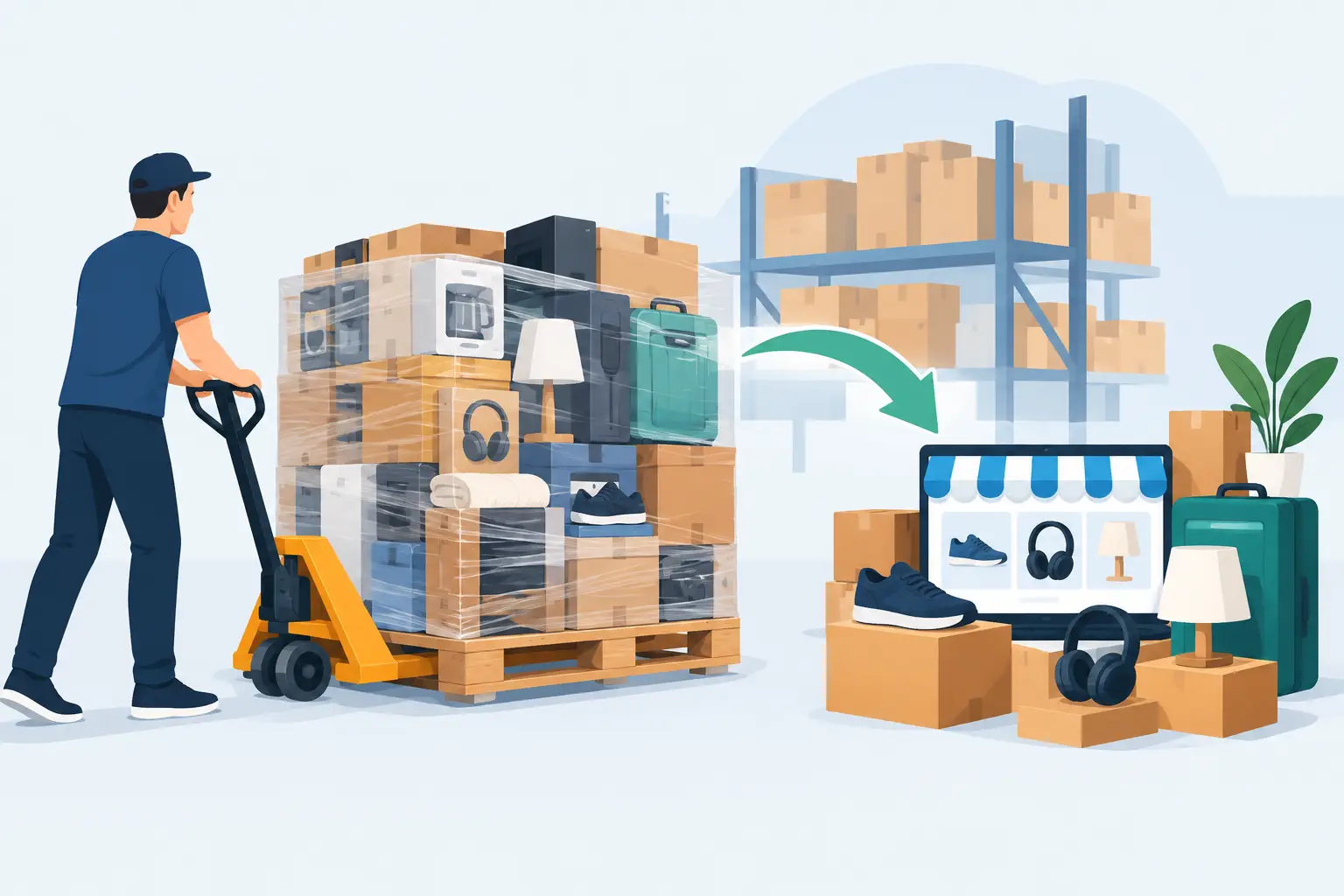
A pallet can look profitable from across a warehouse and still drain your cash once it reaches your door. That is why liquidation pallets should be bought as inventory decisions, not lottery tickets. The difference is knowing what is on the pallet, what condition it is in, what it will cost to move, and where you can resell it fast.
For a resale business, bulk inventory can create real buying power. One well-chosen pallet may supply weeks of listings, stock a discount-store section, or fill tables at a flea market. But the pallet has to match your sales channel and your capacity. A mixed general merchandise load may suit an experienced seller with several outlets, while a manifested footwear pallet can be a better first purchase for someone selling on eBay, social platforms, or a local storefront.
What Makes Liquidation Pallets Worth Buying?
Liquidation inventory comes from overstock, customer returns, shelf pulls, closeouts, and surplus merchandise moving out of retail channels. Major retailers need room for new inventory, and resale operators get access to goods at wholesale pricing. The opportunity is straightforward: buy below likely resale value, sort efficiently, and sell through before your capital gets stuck in slow-moving stock.
The real value is not the retailer name printed on the listing. It is the combination of product mix, condition, demand, and your ability to sell the items. A pallet of familiar brands can still be a poor buy if it contains heavy freight-sensitive goods, outdated products, or items your customer base does not want. On the other hand, a pallet with modest estimated retail value can produce healthy margins when the items are current, easy to ship, and easy to price.
This is where many new buyers make a costly mistake. They compare the pallet price only against the stated retail value and assume the difference is profit. Retail value is a reference point, not cash in hand. Your actual return depends on sell-through rate, marketplace fees, shipping supplies, labor, storage, local demand, and the percentage of inventory that needs repair, bundling, or liquidation again.
Start With the Manifest, Not the Headline Price
A manifest is your best defense against speculative buying. It identifies the items on a pallet or provides a detailed product breakdown, often including quantities, descriptions, model numbers, sizes, colors, and stated retail values. It lets you research resale prices before you commit your money.
When reviewing a manifest, do not assume every listed item will sell at full retail. Search for completed sales or current local demand in the condition you expect to receive. A popular pair of branded work boots, a current power tool accessory, or a practical household item may move quickly. A niche accessory with a high original price may sit for months.
Use the manifest to answer three practical questions: Can you identify the products? Do you have a proven place to sell them? Is there enough margin after every cost is included? If the answer is unclear, the pallet may be too risky at its current price.
Real product photos matter for the same reason. Photos can reveal retail packaging condition, product variety, visible damage, and whether the pallet matches the inventory description. Stock photos tell you what an item looked like when it was new. Actual photos help show what you are purchasing now.
Know the Grade Before You Set a Resale Price
Condition grades are not fine print. They determine how you inspect, list, price, and handle the inventory when it arrives. Every supplier may use slightly different terms, so read the condition definition tied to the specific pallet rather than relying on a label alone.
New or overstock inventory generally offers the cleanest path to resale. These items may be excess retailer inventory, shelf pulls, or discontinued stock and often retain original packaging. They can work well for online listings, discount stores, and giftable merchandise, although packaging may still show handling wear.
Customer returns require more work and more discipline. Some returns are unused products sent back because of sizing, duplicate purchases, or buyer preference. Others may have missing packaging, cosmetic flaws, incomplete parts, or functional issues. Returns can deliver strong margins, but only if your buying price accounts for testing, cleaning, sorting, and occasional losses.
Salvage inventory belongs in a different business plan. It may be suitable for parts, repair, component recovery, or highly experienced discount sellers. It is not the right choice for a first pallet buyer expecting ready-to-list merchandise. Buying a lower grade to save money often costs more when you do not have a reliable process for moving imperfect goods.
Choose a Category You Can Actually Move
A broad mixed pallet gives you variety, but variety creates work. You may receive apparel, kitchen goods, small electronics, toys, and seasonal products in one shipment. That can be useful for bin stores, flea-market vendors, and sellers with multiple sales channels. It can also slow down an online-only seller who must photograph, test, research, and list every different item.
Category-focused pallets are often easier to manage. Branded footwear gives you recognizable product names and straightforward size-based listings. Apparel can work well if you understand sizing, seasonality, and brand demand. Tools, auto parts, camping gear, and household goods can perform well when you know the product category and can verify completeness.
Electronics deserve extra care. They may offer strong individual resale prices, but they also bring higher testing requirements, compatibility questions, account-lock concerns, and return risk. If you are new to electronics, start with inventory that has clear model information and a condition grade you can support with your selling process.
Your location matters too. Heavy equipment, large household goods, and bulky returns may be excellent for local pickup or a physical store but expensive to ship one item at a time. Small, durable products can be more attractive for marketplace sellers because packing and delivery are simpler. Profit is often won or lost after the pallet arrives, not when the order is placed.
Build the Full Cost Into Your Bid or Buy Price
The pallet price is only one line in the equation. Add freight, unloading, storage, marketplace fees, packing materials, labor, repair costs, and a realistic allowance for unsellable inventory. If you need a liftgate, loading help, or a storage unit, account for that before purchasing.
A simple working target is to estimate conservative resale revenue, then subtract every cost before deciding what you can pay. Conservative means you price based on likely selling prices, not the highest asking price you can find online. It also means assuming some items will be incomplete, slow-moving, or worth bundling rather than listing individually.
For example, a pallet with an estimated retail value of $6,000 is not automatically a $6,000 opportunity. If your realistic recovery is 35% to 45% of retail, your projected gross sales may be $2,100 to $2,700. From there, subtract the pallet cost, freight, fees, and operating costs. That calculation may still leave an attractive margin, but it keeps you from paying for a dream instead of inventory.
What to Check Before Ordering a Pallet
Before you buy, confirm the grade definition, review the manifest, inspect actual pallet photos, and understand the shipping terms. Check whether the pallet is retailer-origin inventory, mixed returns, overstock, or another source type. Those details affect both condition expectations and resale strategy.
Also confirm your receiving plan. Know where the freight will be delivered, whether someone can inspect the shipment at arrival, and how quickly you can sort it. The best time to document visible freight damage is when the pallet arrives, not after it has been broken down and moved around.
At Wholesale Pallet Depot, the focus is on inspected, graded, and accurately described inventory so buyers can choose based on real product visibility rather than mystery-pallet promises. That does not remove every resale risk, because liquidation is still inventory with variables. It gives you the information needed to make a business decision with your eyes open.
Turn Arrival Day Into a Selling Advantage
Treat receiving day like the first day of a sales campaign. Photograph the pallet before opening it, compare the contents against the manifest, and separate products into sell-now, test-or-clean, bundle, and problem categories. This protects your records and stops questionable items from mixing with resale-ready stock.
List the easiest, highest-demand products first. Fast listings create cash flow and show you whether your initial pricing is right. For lower-value items, consider bundles, local lots, clearance tables, or live-selling formats instead of spending ten minutes writing a detailed listing for a five-dollar product.
Track what sells, not just what looks valuable. Over time, your strongest pallet categories will become obvious. You may find that modest household staples beat flashy returns, or that branded shoes produce better margins than mixed electronics because they take less time to process. Those results are more useful than any seller’s promise about a pallet’s potential.
The right pallet is the one you can inspect with confidence, receive without chaos, and turn into inventory your customers already know how to buy. Start with clear information, price for reality, and let each shipment teach you what to order next.