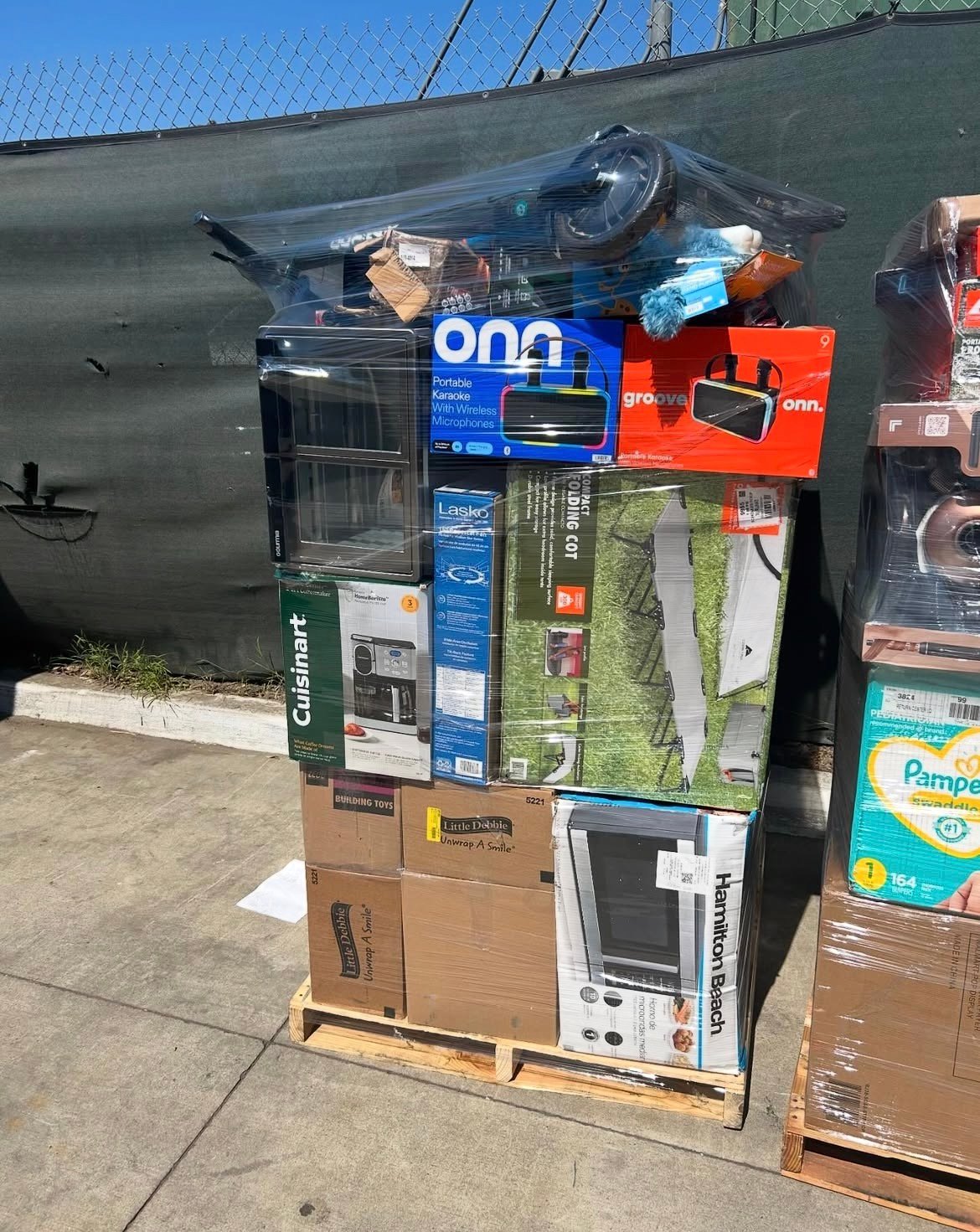
If you have been paying attention to the liquidation reselling space over the past two years, you have almost certainly seen the bin store trend exploding across the country.
Bin stores — also called dollar bin stores, pallet bin stores, or treasure stores are physical retail locations where liquidation merchandise is dumped into large bins and sold at a flat price per item. Customers pay $5, $3, $2, or $1 per item depending on what day of the week it is, with prices dropping progressively throughout the week to clear inventory before a fresh pallet drops on a new cycle day.
The business model is simple, the customer experience is genuinely addictive, and the profit potential from liquidation pallets is real which is exactly why bin stores have grown from a niche regional concept to a nationally recognized retail format that attracts thousands of shoppers every single week.
This guide gives you the complete picture of how to start a bin store business with liquidation pallets in 2026. The business model mechanics, startup costs, location strategy, inventory sourcing, pricing cycle setup, staffing considerations, and how Wholesale Pallet Depot can supply the consistent, diverse liquidation inventory that keeps your bins stocked and your customers coming back every week.
Bin Store Liquidation Pallets — What Is a Bin Store and Why Is This Model Growing So Fast
Bin Store Liquidation Pallets — The Business Model Explained Simply
A bin store is a physical retail location that purchases liquidation pallets in bulk, unpacks them into large open bins on the sales floor, and sells each item at a flat price per piece regardless of what the item is. The pricing structure typically follows a weekly cycle where prices drop each day until a reset day usually Monday or Tuesday when fresh inventory is loaded and prices return to the highest tier.
A common bin store pricing cycle looks like this:
| Day | Price Per Item |
|---|---|
| Monday (Fresh Drop Day) | $7 – $10 per item |
| Tuesday | $5 per item |
| Wednesday | $3 per item |
| Thursday | $2 per item |
| Friday | $1 per item |
| Saturday | $0.50 or bag sale |
| Sunday | Restock and reset |
This pricing structure creates a powerful psychological dynamic. Customers who want first pick of the fresh inventory come on Monday and pay the highest price. Bargain hunters who want the deepest discounts come on Friday when everything is $1. Most customers end up coming multiple times per week because they know the inventory changes and the prices drop creating the kind of repeat foot traffic that most retail businesses can only dream of.
Bin Store Liquidation Pallets — Why This Model Has Exploded in Popularity
The bin store concept has grown dramatically for several converging reasons that make 2026 particularly well-timed for new entrants.
Consumer appetite for treasure hunting experiences has grown significantly alongside the broader resale economy. Shoppers who grew up watching unboxing videos and thrift store haul content on social media are naturally drawn to the bin store format. it delivers the same discovery-based experience in a physical retail setting.
The supply of liquidation inventory has never been larger. According to the National Retail Federation’s 2025 Retail Returns Landscape report, an estimated 19.3% of online sales were returned in 2025 alone — meaning more merchandise is flowing through liquidation channels than ever before, giving bin store operators consistent access to diverse, interesting merchandise that keeps the customer experience fresh from week to week.
And the business model itself rewards the operator with one of the most favorable retail economics available you buy inventory at 10 to 20 percent of retail and sell individual items for prices that collectively return 40 to 80 percent of retail across the weekly cycle. The math works powerfully in the operator’s favor.
Bin Store Liquidation Pallets — Startup Costs and What You Need to Open
Bin Store Liquidation Pallets — Realistic Startup Cost Breakdown
Starting a bin store business with liquidation pallets requires more upfront capital than a home-based reselling operation but significantly less than most traditional retail concepts. Here is a realistic breakdown of what you need to open:
| Expense | Estimated Cost | Notes |
|---|---|---|
| First month rent and deposit | $2,000 – $6,000 | Depends on location size and market |
| Build out and shelving | $2,000 – $8,000 | Bins, tables, signage, basic improvements |
| Initial inventory (pallets) | $3,000 – $8,000 | 8 to 20 pallets for opening stock |
| Point of sale system | $200 – $500 | Square or similar with receipt printer |
| Security camera system | $300 – $800 | Essential for loss prevention |
| Business registration and permits | $200 – $600 | LLC, business license, resale certificate |
| Insurance | $100 – $300/month | General liability minimum |
| Marketing and signage | $500 – $1,500 | Grand opening promotion, exterior signage |
| Working capital buffer | $2,000 – $5,000 | 60 to 90 days of operating costs |
| Total Startup Range | $10,000 – $30,000 | Average operator starts around $15,000 |
The wide range reflects the significant variation in commercial real estate costs across different markets. A bin store in a small city with affordable retail space can open for $10,000 to $15,000. A similar concept in a higher-cost urban market might require $25,000 or more before opening day.
Before you open your doors, two line items above are worth researching properly rather than guessing at: for business licensing, the U.S. Small Business Administration’s guide to applying for licenses and permits breaks down federal, state, and local requirements by business type. For insurance, the SBA’s guide to getting business insurance explains what coverage is legally required versus recommended for a retail storefront.
Bin Store Liquidation Pallets — What You Can Open With Less Capital
Many successful bin store operators start smaller than the figures above suggest by making strategic choices that reduce initial capital requirements without compromising the customer experience:
Start with a smaller space. A 1,000 to 1,500 square foot location requires less rent, less build-out cost, and less inventory to fill. It is also easier to manage as a new operator still learning the rhythm of the business. Many operators start small and expand into adjacent space once the business is proven.
Source used bins and shelving. New bin systems can be expensive. Used warehouse bins, industrial shelving, and plastic storage totes work perfectly well and can be found affordably through Facebook Marketplace, commercial liquidation sales, or restaurant supply stores.
Open in a lower-rent market first. Some of the most profitable bin stores in the country operate in small to mid-size cities where commercial rent is low but the local population has strong appetite for discount retail. A $1,000 per month space in a secondary market can outperform a $4,000 per month space in a major metro if the local competition is lower.
Bin Store Liquidation Pallets — Location Strategy for Maximum Foot Traffic
Bin Store Liquidation Pallets — What to Look for in a Bin Store Location
Location is the single most important factor in bin store success after inventory quality. The right location can make a mediocre operator profitable. The wrong location can sink a well-run operation with great inventory.
Target high-visibility, high-traffic retail corridors. Your bin store needs spontaneous walk-in traffic from people who had not planned to visit but were drawn in by curiosity. This requires being in a location where foot traffic and vehicle traffic are consistently high strip malls with anchor tenants like grocery stores or dollar stores, busy commercial streets, or retail corridors with strong existing discount retail presence.
Look for spaces near complementary businesses. Thrift stores, dollar stores, flea market strips, and discount grocery stores attract the same demographic as a bin store. Being near these businesses means you benefit from their existing foot traffic rather than having to generate yours from scratch.
Evaluate parking carefully. A bin store customer often stays 30 to 60 minutes, browses multiple bins, and sometimes makes multiple trips per week. Adequate, convenient parking is essential. A location with difficult parking loses customers to competitors with easier access regardless of inventory quality.
Assess the local demographic. Bin stores perform strongest in markets where value-conscious shopping is culturally ingrained and where the disposable income range supports $5 to $10 per item impulse purchases comfortably. Working-class and middle-income markets typically outperform high-income markets for bin store concepts.
Bin Store Liquidation Pallets — Inventory Strategy and How Much You Need
Bin Store Liquidation Pallets — How Many Pallets Does a Bin Store Need Per Week
Inventory volume is the lifeblood of a bin store operation. Without enough merchandise to fill your bins attractively on each drop day, the customer experience suffers and repeat visits drop sharply.
Here is a general guide to weekly inventory requirements by store size:
| Store Size | Floor Space | Bins | Pallets Per Week | Estimated Weekly Inventory Cost |
|---|---|---|---|---|
| Small | 800 – 1,200 sq ft | 20 – 30 bins | 4 – 6 pallets | $800 – $1,500 |
| Medium | 1,500 – 2,500 sq ft | 40 – 60 bins | 8 – 12 pallets | $1,600 – $3,000 |
| Large | 3,000 – 5,000 sq ft | 80 – 120 bins | 15 – 25 pallets | $3,000 – $6,000 |
These estimates assume mixed general merchandise pallets at $200 to $400 each. Your actual cost depends on your specific pallet mix and supplier pricing.
Bin Store Liquidation Pallets — What Types of Liquidation Pallets Work Best for Bin Stores
Not all liquidation pallets are equally suitable for the bin store format. The best bin store inventory has certain characteristics that make it attractive in the bin shopping environment:
High variety within each pallet. Customers browsing bins want to discover different things each time they visit. Mixed general merchandise pallets that contain dozens of different item types create a more compelling browse experience than pallets of all one category.
Small to medium item sizes. Bin stores work best with items that fit comfortably in a bin and can be picked up and examined easily by a standing customer. Oversized items like large appliances or furniture do not translate well to the bin format price them separately on shelving.
Broad category representation. Clothing, toys, electronics accessories, home goods, sporting goods accessories, beauty products, kitchen gadgets, and general merchandise all perform well in the bin format because they appeal to the broadest range of customers who walk through your door.
Grade B merchandise is often ideal. Unlike online reselling where condition descriptions are critical, bin stores allow customers to see and evaluate items directly before purchasing. Grade B customer returns merchandise that would require careful description online sells easily in person when a customer can hold it and assess the condition themselves.
Bin Store Liquidation Pallets — The Weekly Operations Cycle
Bin Store Liquidation Pallets — How to Run Your Drop Day Efficiently
Drop day is the most important operational day of your bin store week. How efficiently you execute the transition from old inventory to fresh inventory determines whether you open on time with full bins and an enthusiastic crowd, or open late with half-filled bins and disappointed early customers.
Pre-drop day preparation (Sunday or the evening before):
- Pull all remaining inventory from bins to a staging area
- Clean and sanitize all bins
- Sort incoming pallets into categories before loading begins
- Price and organize any high-value items that will be displayed on separate shelving rather than bins
- Brief any staff on the new inventory categories and any special items
Drop day execution:
- Open pallets and distribute merchandise across bins by category
- Load bins to at least 80 percent capacity — full bins create the treasure hunt atmosphere that drives the bin store experience
- Set up featured items on shelving or end caps for items too valuable or too large for bins
- Take photos of the fresh drop for social media posting before opening
- Open doors on time — early customers specifically plan their day around your drop schedule and lateness damages trust
During the day:
- Rotate bin contents periodically — items buried under other merchandise get discovered when you stir the bins
- Monitor theft — bin stores have higher shrinkage rates than traditional retail and active floor presence reduces losses significantly
- Track which categories are selling fastest to inform next week’s buying decisions
Bin Store Liquidation Pallets — Pricing Strategy and Revenue Model
Bin Store Liquidation Pallets — How to Calculate Whether Your Bin Store Is Profitable
The economics of a bin store are actually quite straightforward once you understand the sell-through rates at each price tier. Here is a realistic revenue model for a medium-sized bin store using 10 pallets per week at an average cost of $250 per pallet:
Weekly inventory investment: $2,500 (10 pallets at $250 average)
Estimated retail value of 10 pallets: $12,500 (at 5x retail value multiple)
Item count estimate: 600 to 800 items across 10 mixed pallets
Revenue by pricing day (realistic sell-through estimates):
| Day | Price | Items Sold | Revenue |
|---|---|---|---|
| Monday | $8 | 120 items | $960 |
| Tuesday | $5 | 150 items | $750 |
| Wednesday | $3 | 160 items | $480 |
| Thursday | $2 | 130 items | $260 |
| Friday | $1 | 150 items | $150 |
| Saturday | $0.50 | 50 items | $25 |
| Total | 760 items | $2,625 |
Weekly gross profit: $2,625 revenue − $2,500 inventory cost = $125 gross profit
That looks slim. But this model does not account for the fact that many items sell on early days at higher prices. Here is the same model with a more favorable but still realistic early-day sell-through:
| Day | Price | Items Sold | Revenue |
|---|---|---|---|
| Monday | $8 | 200 items | $1,600 |
| Tuesday | $5 | 180 items | $900 |
| Wednesday | $3 | 140 items | $420 |
| Thursday | $2 | 100 items | $200 |
| Friday | $1 | 80 items | $80 |
| Saturday | $0.50 | 40 items | $20 |
| Total | 740 items | $3,220 |
Weekly gross profit: $3,220 − $2,500 = $720 gross profit
Monthly gross profit: $720 × 4.3 weeks = approximately $3,096
From this monthly gross profit you subtract your rent, utilities, staff costs, insurance, and other operating expenses to arrive at net profit. A well-run medium bin store in a moderate-rent market can generate $1,500 to $4,000 in monthly net profit a meaningful income that can grow significantly as your operation scales and your customer base builds.
For a deeper look at pricing psychology across price tiers, see our guide on how to price liquidation items to sell fast without leaving money on the table.
Bin Store Liquidation Pallets — Why Wholesale Pallet Depot Is the Right Supplier for Bin Stores
Bin Store Liquidation Pallets — What Bin Store Operators Need From a Supplier
A bin store operator has specific inventory needs that differ from home-based resellers. You need consistent weekly volume, diverse category mix, and reliable delivery scheduling that fits your drop day calendar. A supplier who cannot deliver consistently disrupts your weekly cycle and damages the customer experience that drives your repeat business.
Wholesale Pallet Depot supports bin store operators with:
Consistent, regularly available inventory. Our catalog updates regularly from established retail supply chain partnerships. You are not hunting for available pallets week to week, we have inventory ready when you need it.
Diverse category mix across pallets. Our general merchandise pallets provide the variety that creates the compelling bin shopping experience your customers expect. Mix in our clothing, accessories, and customer returns pallets for category diversity that keeps your bins interesting across every shopping day.
Honest condition grading and transparent descriptions. At bin store volume, surprises in your inventory can disrupt your pricing cycle and customer experience. Our honest grading means you know what to expect before your delivery arrives — see our full refund and returns policy for how we stand behind that.
Nationwide shipping with reliable scheduling. We ship to every state with consistent freight partners and full tracking so you can plan your drop day preparation around a reliable delivery window — details available on our shipping policy page.
Call our team at (719) 321-6761 to discuss your weekly volume needs and how we can support your bin store operation specifically, or reach out through our contact page. Browse current inventory at wholesalepalletdepot.shop/shop.
FAQs About Bin Store Liquidation Pallets
Bin Store Liquidation Pallets FAQ — How much does it cost to start a bin store with liquidation pallets?
Starting a bin store with liquidation pallets typically costs $10,000 to $30,000 depending on your market’s commercial real estate costs, space size, and build-out requirements. Operators in lower-rent secondary markets can open for as little as $10,000 to $15,000. Higher-cost urban markets may require $25,000 or more before opening day.
Bin Store Liquidation Pallets FAQ — How profitable is a bin store business?
A well-run medium-sized bin store processing 10 pallets per week can generate $1,500 to $4,000 per month in net profit after rent, staff, and operating costs. Larger stores with strong customer bases and higher volume can generate significantly more. Profitability depends heavily on location quality, inventory sourcing, and operational efficiency.
Bin Store Liquidation Pallets FAQ — How many pallets does a bin store need per week?
A small bin store needs 4 to 6 pallets per week. A medium store needs 8 to 12 pallets per week. A large store needs 15 to 25 pallets per week. The right volume depends on your store size, bin count, and how aggressively you price down through the weekly cycle.
Bin Store Liquidation Pallets FAQ — What types of liquidation pallets work best for bin stores?
Mixed general merchandise pallets with high variety, small to medium item sizes, and broad category representation work best in the bin format. Grade B customer returns are particularly well-suited because customers can evaluate condition directly in person. Avoid oversized items and highly specialized niche merchandise that appeals to only a small portion of your customer base.
Bin Store Liquidation Pallets FAQ — How does the weekly pricing cycle work in a bin store?
Most bin stores start fresh inventory at $7 to $10 per item on drop day, then reduce prices daily until reaching $1 or $0.50 by the end of the week. This creates multiple reasons for customers to visit — fresh inventory seekers come on drop day at full price, bargain hunters come at the end of the week for deep discounts. The cycle resets weekly with fresh pallet inventory.
Bin Store Liquidation Pallets FAQ — What is the biggest challenge in running a bin store?
Consistent inventory sourcing is the biggest operational challenge for most bin store operators. Without a reliable supplier who can deliver the right volume of diverse merchandise on a weekly schedule, your drop days become inconsistent and customer trust erodes. Establishing a strong supplier relationship with a company like Wholesale Pallet Depot before opening is one of the most important pre-launch steps.
Bin Store Liquidation Pallets FAQ — Do I need employees to run a bin store?
Most bin stores require at least one additional staff member during business hours for customer service, loss prevention, and bin maintenance. Drop day typically requires two to four people to unpack pallets and fill bins efficiently before opening. Solo operation is possible in very small stores but limits your capacity and creates significant personal time commitment.
Bin Store Liquidation Pallets FAQ — How do I market my bin store to attract customers?
Social media — particularly TikTok, Instagram, and Facebook — is the most effective marketing channel for bin stores because drop day videos of fresh inventory create organic excitement that drives foot traffic better than traditional advertising. Post drop day content every week, show what is in the bins, and highlight interesting finds. Local Facebook groups and community pages are also strong channels for reaching your local buyer demographic.
Bin Store Liquidation Pallets FAQ — What size space do I need to open a bin store?
Most successful bin stores operate in 1,000 to 3,000 square feet. A 1,000 to 1,500 square foot starter location accommodates 20 to 40 bins and is manageable for a small operation. As your customer base grows, expanding to a larger space or opening a second location becomes a natural next step.
Bin Store Liquidation Pallets FAQ — Where can I buy liquidation pallets for my bin store?
Wholesale Pallet Depot offers consistent, honestly graded mixed merchandise and category-specific liquidation pallets suitable for bin store operations of all sizes. Call our team at (719) 321-6761 to discuss your weekly volume needs and which pallet mix works best for your specific store concept.
Related Reading
- How to Scale Your Pallet Reselling Business from $1,000 to $10,000 Per Month in 2026
- How to Build a Full-Time Income Flipping Liquidation Pallets from Home in 2026
- Best Platforms to Sell Liquidation Pallet Items in 2026 Ranked by Profit Potential
Ready to Open Your Bin Store with Liquidation Pallets?
The bin store business model is one of the most compelling retail concepts available in 2026 — compelling customer experience, strong unit economics, low barrier to entry compared to traditional retail, and a supply of liquidation inventory that has never been more abundant.
The foundation of every successful bin store is a reliable inventory supplier who can deliver consistent weekly volume at honest prices. Wholesale Pallet Depot is ready to be that partner for your bin store operation.
👉 Browse all liquidation pallets for sale at wholesalepalletdepot.shop
📧 Contact us: wholesalepalletdepot.shop/contact
Wholesale Pallet Depot — Your trusted national source for liquidation pallets for sale. Verified inventory, honest grading, and real customer support — shipped to your door anywhere in the country. Read our FAQ or learn more about us.