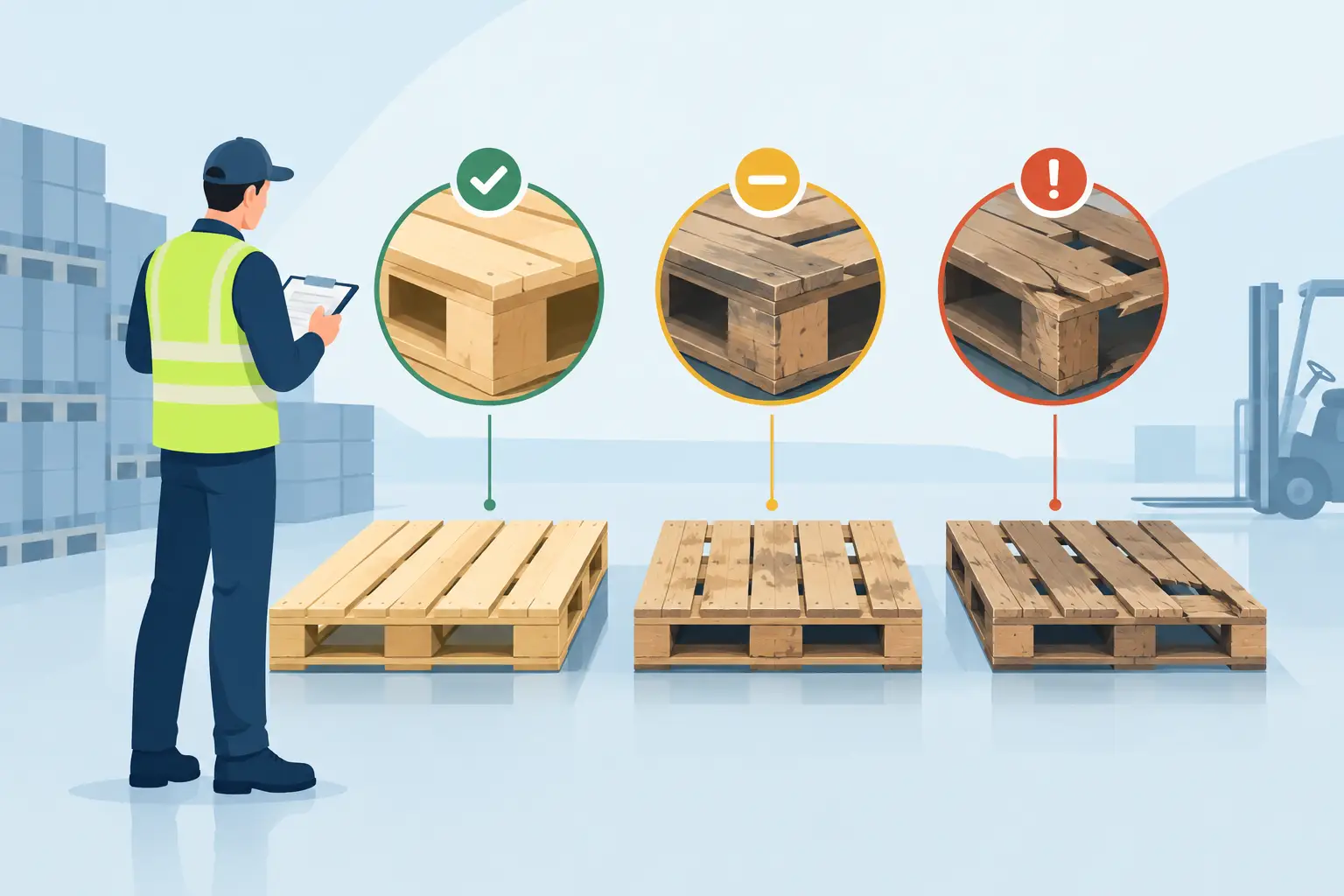
A pallet can look profitable on paper and still become expensive inventory if its condition does not match your selling model. That is why pallet condition grading matters before you place an order. A clear grade tells you whether you are buying shelf-ready goods, open-box products, customer returns, salvageable inventory, or a mix that requires more labor before resale.
For a reseller, condition is not a minor detail buried in a listing. It affects your selling price, return rate, prep time, storage needs, and cash flow. The goal is not to find a pallet with zero risk. Liquidation always involves some variation. The goal is to understand the risk before you pay for it.
What pallet condition grading tells you
Pallet condition grading is a practical system for describing the expected state of merchandise in a wholesale load. It gives buyers a baseline for how products, packaging, accessories, and functionality may present when the pallet arrives.
A grade should help you answer the questions that determine whether inventory fits your operation: Can I list these items as new? Will I need to test them? Are missing parts likely? Is this better for a discount store, a flea market, online resale, or repair and parts recovery?
Grades are not a substitute for a manifest, photos, or common business judgment. They work best as part of a complete picture. A pallet described as customer returns, for example, may contain products that are unused, opened but complete, defective, or missing components. The grade establishes the broad condition range. The manifest and real photos provide the item-level context that lets you price the opportunity realistically.
Common pallet grades and what they mean for resale
Condition terminology can differ between suppliers, retailers, and product categories. A grade label only has value when the seller explains what it means. Still, most liquidation inventory falls into a few common groups.
New and overstock inventory
New or overstock inventory is typically unused merchandise that retailers did not sell through their normal channels. It may have been discontinued, seasonal, replaced by a newer model, or removed during a store reset. Products are generally expected to be in new condition, though outer packaging can show warehouse handling, labels, tape, or light wear.
This is often the easiest inventory to move through online marketplaces, independent retail stores, social selling, and gift-focused sales. It also usually carries a higher wholesale cost because buyers can reasonably expect stronger resale value and less prep work. Do not assume every box will be perfect. Verify whether packaging condition is included in the grade, especially for collectible items, branded footwear, electronics, and products sold as gifts.
Like-new and open-box inventory
Like-new and open-box pallets often contain products that were opened, displayed, inspected, or returned with little to no use. Some items may retain original packaging; others may arrive in replacement packaging or with packaging that has been opened and resealed.
This category can create strong margins for resellers who are willing to inspect inventory. A cordless tool, small appliance, watch, or camping item in excellent working condition may sell well even if the box is imperfect. The trade-off is that you must check accessories, verify functionality where appropriate, and use accurate listing language. Selling an open-box product as factory-sealed creates avoidable returns and damages your reputation.
Customer returns
Customer returns are one of the broadest and most misunderstood liquidation categories. They are not automatically damaged, and they are not automatically resale-ready. A customer may return an item because it arrived late, did not fit, had a cosmetic flaw, lacked a needed feature, or simply was not wanted. Other returns may be used, incomplete, defective, or substituted in error.
Returns pallets can be excellent for experienced operators because the purchase price often reflects the added uncertainty. They are especially useful when you have a testing process, a local outlet, a repair channel, or a sales strategy for multiple condition levels. Electronics and power equipment need more attention than apparel or books because functional testing can make the difference between profit and dead stock.
Used, uninspected, and salvage inventory
Used or salvage inventory carries a higher level of uncertainty. Products may have visible wear, missing parts, broken packaging, functional issues, or damage that limits them to repair, parts, or clearance sales. Uninspected loads may have even less item-level verification.
These pallets are not necessarily bad buys. They are simply a different business model. A repair shop, parts seller, bargain-bin store, or experienced flea-market vendor may turn salvage goods into dependable revenue. A new seller hoping to list every item quickly on a premium marketplace may not. The lower purchase price only helps if your labor, testing, disposal, and customer-service costs stay under control.
Grade is only useful when the details support it
A vague grade label creates more questions than confidence. Serious liquidation buyers should look for evidence that supports the stated condition. That includes clear product photos, a detailed manifest when available, retailer or source information, estimated retail values that are grounded in actual products, and direct language about defects or mixed conditions.
Pay close attention to whether a manifest lists quantities, product names, model numbers, UPCs, retail prices, and condition notes. A manifest is not a guarantee that every item will perform perfectly, particularly in return inventory. It is a planning tool. It lets you research resale demand, identify slow-moving items, estimate listing effort, and decide whether the pallet supports your target margin.
Real photos matter for the same reason. Stock photos show what a product looked like at retail. Photos of the actual pallet show what you may receive: box condition, assortment depth, visible damage, packaging variation, and how inventory is packed. If a seller cannot provide a meaningful description beyond a large retail-value number, treat that as a warning sign rather than a bargain.
Match the grade to your sales channel
The right pallet grade depends on how you sell. There is no single “best” condition level for every reseller.
Online marketplace sellers generally benefit from new, overstock, and carefully described open-box goods. These channels reward accurate listings, clean photos, complete accessories, and predictable fulfillment. The more customer expectations matter, the more value there is in condition consistency.
Discount-store operators can often use a wider range of grades. A store can separate new items, open-box deals, and clearance merchandise into different sections, allowing customers to choose based on price and condition. This flexibility can make customer returns and mixed general merchandise more workable than they would be for a single-channel online seller.
Flea-market vendors, live sellers, and local resellers may do well with mixed-condition pallets if they can inspect quickly and price clearly. Buyers in these channels often appreciate a deal, but they still expect honesty. Mark used goods as used, test electronics before presenting them as working, and reserve damaged or incomplete items for parts, repair, or deeply discounted sales.
Build condition into your buying math
Do not calculate profit from estimated retail value alone. Retail value is a reference point, not your expected sales total. Your actual recovery depends on condition, demand, brand, seasonality, selling fees, shipping, labor, and the channel where you sell.
Before buying, estimate how much of the pallet you can sell at each condition level. You might expect a portion of open-box goods to sell near standard market pricing, another portion to move at a discount, and a small share to require bundling, repair, or liquidation. This approach is more conservative than assuming every item will sell at full retail, and it gives you a more useful picture of margin.
Include labor in the equation. A lower-cost returns pallet can be profitable, but only if your team has time to unload, sort, test, photograph, clean, list, pack, and handle questions. If you need inventory you can move fast, paying more for inspected, graded, and accurately described merchandise may produce better cash flow than chasing the lowest purchase price.
Questions to ask before you order
Before committing to a pallet, confirm the grade definition and ask whether the load is manifested, inspected, or sold as uninspected returns. Review the actual photos and determine whether the category matches your ability to test and resell it. Check if accessories, chargers, manuals, tags, or original packaging are expected to be present.
You should also ask yourself where the inventory will go if it does not meet your first resale plan. Can open-box items move through your local store? Can incomplete tools be sold for parts? Can apparel with damaged packaging still sell through live auctions? A backup channel protects your margin when condition varies.
At Wholesale Pallet Depot, the point of grading and manifesting is straightforward: give buyers enough visibility to choose inventory with intent, not gamble on a mystery load. The more accurately you can forecast condition and resale effort, the more confidently you can buy.
The next profitable pallet is not always the one with the biggest claimed retail value. It is the one whose condition you can understand, whose products you can sell honestly, and whose workload fits the business you are building.