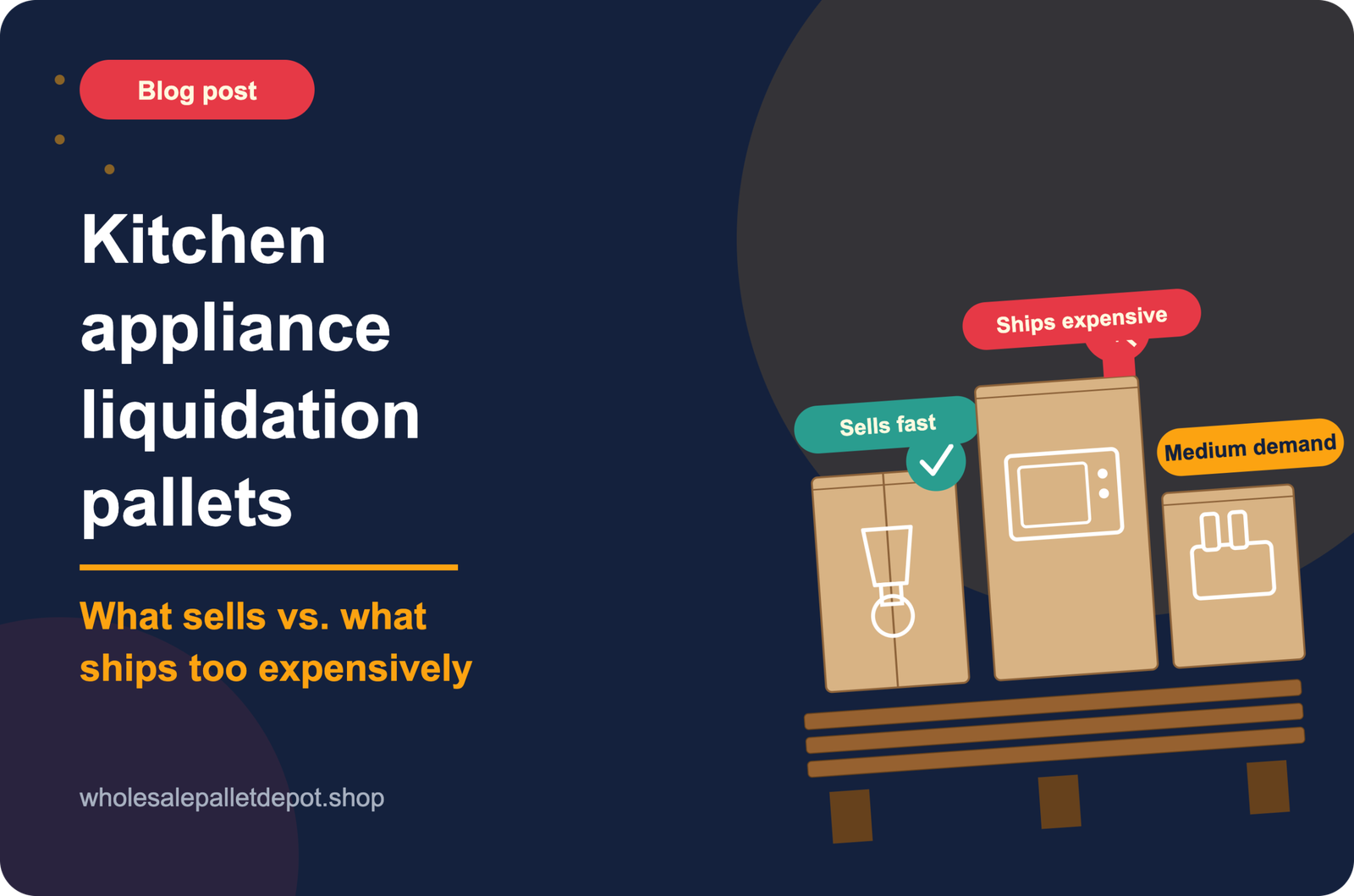
Every liquidation pallet listing I come across for kitchen appliances reads pretty much the same way: “50+ units, brand-new condition, unbeatable prices, buy now.” What almost nobody talks about is the number that actually determines whether that pallet makes you money or quietly eats your margin before you’ve sold a single item — freight.
Kitchen appliance liquidation pallets are one of the most consistently in-demand categories in the entire liquidation space, and for good reason. Nearly every household owns a blender, a coffee maker, and an air fryer, which means demand is broad and steady all year round. But “kitchen appliances” covers an enormous range of weight, size, and shipping complexity, from a five-pound electric kettle to a two-hundred-pound dishwasher. Treating all of it the same way is exactly how new resellers end up disappointed with a category that, done right, is genuinely one of the better ones to be in.
Kitchen Appliance Liquidation Pallets — Why This Category Is So Popular
Kitchen Appliance Liquidation Pallets — The Demand Is Real and It’s Constant
Unlike seasonal categories like holiday decor or swimwear, kitchen appliances sell year-round. People replace a broken blender in January just as readily as they do in July. That steady baseline demand is a big part of why wholesale kitchen appliance pallets show up so consistently across liquidation platforms. suppliers know this category moves, and resellers keep coming back to it because it doesn’t require you to time your buying around a season.
The other reason this category performs well is the price point itself. A household typically owns one refrigerator but several small appliances at once a toaster, a blender, a coffee maker, an air fryer, maybe a stand mixer sitting in a cabinet somewhere. Because the individual purchase price for a small appliance is low, the psychological barrier to buying is low too. People don’t deliberate for a week over whether to buy a $25 toaster the way they might over a major purchase. That makes small kitchen items some of the fastest-moving inventory a reseller can stock.
Kitchen Appliance Liquidation Pallets — What’s Typically Included
Most bulk kitchen appliance pallets contain a genuine mix rather than one single item repeated fifty times. Based on what’s commonly available across suppliers, you can expect to see:
- Blenders and personal blenders
- Air fryers
- Coffee makers, including single-serve pod machines
- Toasters and toaster ovens
- Stand mixers and hand mixers
- Electric kettles
- Food processors
- Microwaves
- Pressure cookers and multi-cookers
- Occasionally larger items like countertop dishwashers or compact refrigerators mixed in
Pallets in this category typically run anywhere from 40 to 100 units, with pricing that varies enormously depending on brand mix, condition, and quantity — figures I’ve seen range from around $550 for a smaller mixed lot up to several thousand dollars for larger, higher-brand-value truckload-style purchases. Brand names commonly appearing in this category include Ninja, Hamilton Beach, Proctor Silex, Black+Decker, and occasionally premium names like KitchenAid or Cuisinart mixed in.
Small Appliance Liquidation Pallets — Why Small Wins on Margin
Small Appliance Liquidation Pallets — The Freight Math Nobody Talks About
Here’s the part that almost every generic pallet listing skips over entirely, and it’s the single biggest factor in whether this category is actually profitable for you: shipping a five-pound coffee maker and shipping a two-hundred-pound refrigerator are two completely different businesses.
Small appliance liquidation pallets, the blenders, toasters, air fryers, and kettles are compact, lightweight, and easy to box individually. That means you can ship them profitably through standard parcel carriers like USPS, UPS, or FedEx, at costs that stay reasonable relative to the item’s resale price. A $12 shipping cost on a $45 air fryer resale still leaves you a healthy margin. This is exactly why small appliances are so well suited to online resale channels like eBay, Amazon, Poshmark, and Facebook Marketplace — you’re not fighting freight costs that eat your profit before you’ve even covered your pallet cost.
Small Appliance Liquidation Pallets — A Smart Trick for the Low-Value Items
Not every item in a mixed pallet is a headline appliance. You’ll often end up with smaller, lower-ticket gadgets — a vegetable chopper, a milk frother, a mini rice cooker — that aren’t worth the time to photograph and list individually. A trick that works well here: bundle three or four of these into a “kitchen starter kit” listing instead of selling them one at a time. A bundle often sells faster and for more combined money than the same items listed separately, and it cuts your per-listing time investment significantly, which matters a lot when you’re processing a full pallet.
Large Appliance Liquidation Shipping — Where the Category Gets Expensive Fast
Large Appliance Liquidation Shipping — Understanding Freight Class
This is where things shift dramatically. Once you’re dealing with a full-size refrigerator, a washing machine, a dryer, or a dishwasher, you’re no longer in parcel-shipping territory. You’re in freight territory, and freight pricing works completely differently. Carriers calculate appliance pallet freight shipping cost based on a combination of actual weight, dimensional weight, and freight class, which accounts for density, value, and how easily an item can be handled and stacked. A large appliance takes up a full pallet position on its own, can’t be stacked under anything else, and often requires liftgate service for delivery since most residential and small-business addresses don’t have a loading dock.
According to Freightquote’s guide to liquidation shipping, proper palletizing and accurate weight and dimension reporting are essential for getting a reliable freight quote. underestimating either one is one of the most common reasons resellers get hit with surprise adjustment fees after the fact. This is a real, industry-recognized cost that’s easy to underestimate if you’ve only ever shipped small parcels before.
Large Appliance Liquidation Shipping — Do the Math Before You Bid
Here’s a simple way to think about it. A single large appliance might cost you $80 to $150 or more just in freight to receive it, on top of your actual pallet or per-unit cost. If that appliance has a cosmetic scratch or dent. extremely common in liquidation and return inventory. your realistic resale price might only be $150 to $300 below retail. Once you subtract freight-in, and then factor in freight-out if you’re shipping it again to a customer rather than selling locally, your margin on that single item can shrink to almost nothing, or turn negative if you haven’t priced carefully.
This doesn’t mean large appliances are never worth buying. It means the math only works in specific situations: buying locally with in-person pickup to avoid freight-in entirely, selling locally through pickup-only listings to avoid freight-out, or working with a supplier who’s geographically close enough that freight costs stay reasonable. Several liquidation programs specifically structure large-appliance truckloads around regional pickup for exactly this reason matching buyers near the distribution center to keep shipping costs from swallowing the deal.
Wholesale Kitchen Appliance Pallets — Where This Inventory Actually Comes From
Wholesale Kitchen Appliance Pallets — Overstock vs Shelf-Pull vs Customer Returns
Not all wholesale kitchen appliance pallets are sourced the same way, and understanding the difference helps you know what you’re actually buying. Overstock inventory refers to items a retailer ordered too much of, or discontinued products being cleared to make room for new models. this stock is typically unused and in original packaging. Shelf-pull inventory is similar but usually comes from floor models or display units that were removed from a retail shelf, which may show minor cosmetic wear from handling even though the item was never sold or used. Customer returns are exactly what they sound like items a shopper bought, used briefly or not at all, and sent back, which introduces the widest range of condition variability.
Most wholesale kitchen appliance pallets you’ll come across are actually a blend of these three sources rather than one single category, which is part of why testing every unit before listing matters so much in this category specifically. A supplier who’s upfront about which of these three categories makes up the bulk of a given pallet is generally more trustworthy than one who simply labels everything “brand new” without specifying the source.
Wholesale Kitchen Appliance Pallets — Reading the Manifest Before You Buy
If your supplier provides a manifest, take the time to actually read through it rather than skimming the total item count. A manifest that breaks down brand names, model numbers, and estimated retail value per item gives you a much clearer picture of what you’re actually paying for than a vague listing that just says “50+ assorted kitchen appliances.” Pallets without a manifest aren’t automatically a bad deal, but they do shift more of the risk onto you as the buyer, since you won’t know the exact contents until the pallet physically arrives.
Appliance Pallet Freight Shipping Cost — Getting an Accurate Quote Before You Buy
Appliance Pallet Freight Shipping Cost — Why Estimating in Advance Matters
One of the most common mistakes I see new buyers make in this category is calculating their expected profit based on the pallet price alone, without ever pulling an actual freight quote first. Your appliance pallet freight shipping cost can vary enormously depending on your distance from the supplier’s warehouse, the total weight of the pallet, and whether any large appliances are mixed in that push the shipment into a higher freight class.
Before you commit to a purchase, it’s worth requesting a freight quote to your specific zip code rather than relying on a general shipping estimate listed on the product page. A pallet that looks like a great deal at $700 can look very different once you add $180 in freight because it happened to include a countertop dishwasher that bumped the whole shipment into a higher weight class. Doing this math up front, rather than after your card’s already been charged, is the difference between a pallet that’s genuinely profitable and one that barely breaks even.
Appliance Pallet Freight Shipping Cost — Questions Worth Asking Your Supplier
A few quick questions can save you a lot of guesswork: Is the pallet strictly small appliances, or does it include anything large enough to require liftgate delivery? Is freight already included in the listed price, or is it calculated separately at checkout? Does the supplier offer local pickup as an option, which can eliminate freight costs entirely if you’re within a reasonable driving distance? Getting clear answers on these before you buy puts you in a much stronger position to judge whether a given pallet is actually the deal it appears to be.
Kitchen Appliance Liquidation Pallets — A Practical Comparison
| Appliance Type | Typical Weight | Shipping Method | Freight Risk | Best Resale Channel |
|---|---|---|---|---|
| Blender / air fryer / toaster | 2–10 lbs | Parcel (USPS/UPS/FedEx) | Low | Online (eBay, Amazon, Marketplace) |
| Coffee maker / stand mixer | 5–15 lbs | Parcel | Low | Online |
| Countertop microwave | 20–35 lbs | Parcel or small freight | Moderate | Online or local pickup |
| Dishwasher / washer / dryer | 100–200+ lbs | Full freight/LTL | High | Local pickup only |
| Refrigerator | 150–300+ lbs | Full freight, liftgate required | Very high | Local pickup only |
The pattern here is straightforward once you see it laid out: the smaller and lighter the item, the more shipping flexibility you have, and the more of your margin you actually keep. This is exactly why experienced resellers in this category tend to favor pallets weighted heavily toward small appliances, and treat any large appliances as a bonus to sell locally rather than the main reason for the purchase.
Kitchen Appliance Liquidation Pallets — Testing and Prepping Before You List
Whatever mix you end up with, testing matters more in this category than almost any other. A quick power test, a wipe-down, and repackaging in a clean box can often turn an “as-is” return into something you can confidently list as “like new,” which meaningfully improves both your sale price and how fast the item moves. For items that don’t power on at all, don’t write them off completely. A non-functional appliance can often still sell as a “for parts or repair” listing, particularly to hobbyists and repair-focused buyers who specifically look for that category.
If you’re newer to processing pallets in general, our guide on how to inspect a liquidation pallet before you buy walks through what to check for before you commit to a purchase, and our guide on how to price liquidation items to sell fast covers the pricing side once your inventory is tested and ready to list.
Where to Buy Kitchen Appliance Liquidation Pallets
At Wholesale Pallet Depot, our Hamilton Beach Appliance Pallets are a solid example of exactly the small-appliance-weighted mix this category performs best with brand-new units across blenders, coffee makers, toasters, and hand mixers, without the freight risk that comes with major appliances. If you’re looking to build out a broader bulk kitchen appliance pallets strategy, browse our full pallets category or reach out through our contact page to ask about current availability across other appliance-adjacent categories.
👉 Browse all liquidation pallets for sale at wholesalepalletdepot.shop
FAQs About Kitchen Appliance Liquidation Pallets
Are kitchen appliance liquidation pallets profitable?
Yes, particularly when the pallet is weighted toward small appliances like blenders, toasters, and air fryers, which ship cheaply and sell quickly online. Profitability drops significantly with large appliances like refrigerators and washers, where freight costs can consume most of your margin unless you’re selling locally.
What’s included in a typical kitchen appliance liquidation pallet?
Most pallets include a mix of blenders, air fryers, coffee makers, toasters, stand mixers, electric kettles, food processors, and similar small appliances, typically 40 to 100 units per pallet. Occasionally larger items like compact refrigerators or countertop dishwashers are mixed in as well.
Why do large appliances cost so much to ship?
Large appliances like refrigerators, washers, and dryers require freight shipping rather than standard parcel delivery, based on their weight, dimensions, and freight class. Most residential deliveries also require liftgate service since standard freight trucks aren’t equipped to unload directly at ground level, adding further cost.
Should I avoid large appliances in liquidation pallets entirely?
Not necessarily, but they should be treated differently than small appliances. Large appliances tend to work best when bought and sold locally through in-person pickup, avoiding freight costs on both ends of the transaction. If you don’t have a way to move large items locally, sticking to small appliance liquidation pallets is generally the safer, more consistently profitable choice.
What brands typically show up in kitchen appliance liquidation pallets?
Common brands include Hamilton Beach, Ninja, Proctor Silex, and Black+Decker, with premium names like KitchenAid or Cuisinart occasionally appearing in higher-value mixed lots.
Where can I buy kitchen appliance liquidation pallets?
Wholesale Pallet Depot offers brand-new Hamilton Beach Appliance Pallets weighted toward small, easy-to-ship appliances. Browse our full shop page for current inventory across all categories.
Wholesale Pallet Depot — Your trusted national source for liquidation pallets for sale. Verified inventory, honest grading, and real customer support — shipped to your door anywhere in the country.