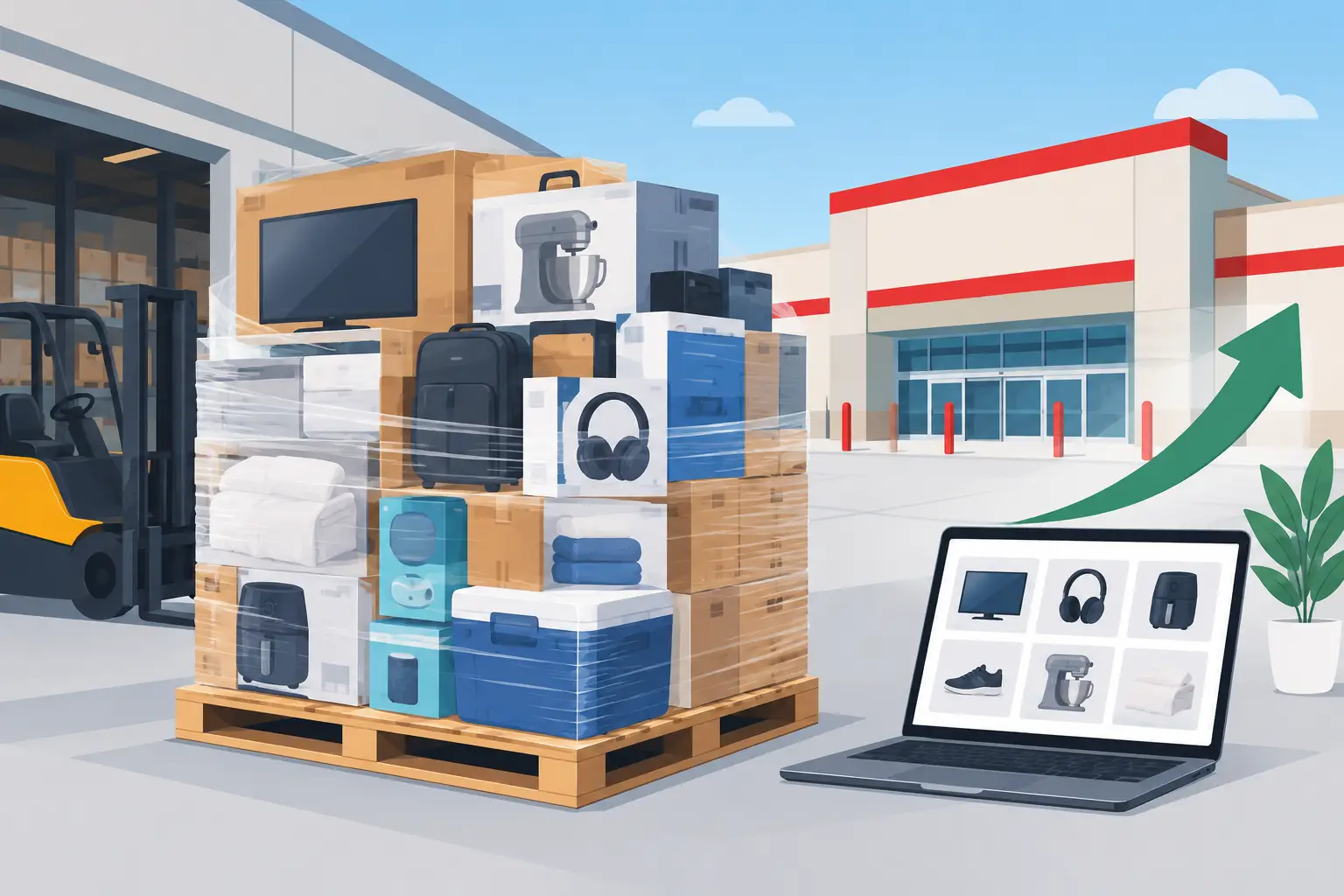
A pallet marked as Costco inventory can look like an easy win: recognizable merchandise, broad consumer demand, and enough units to stock a booth, store, or online listings fast. But Costco liquidation pallets are only profitable when you know what is on the pallet, what condition it is in, and what it will actually cost to get each sellable item into a buyer’s hands.
The smartest resellers do not buy a retailer name alone. They buy documented inventory with a clear grade, real photos, a usable manifest, and a resale plan that fits their market. That is how you avoid paying wholesale prices for a pile of damaged, incomplete, or slow-moving goods.
What Costco Liquidation Pallets Can Include
Costco liquidation inventory may come from overstock, shelf pulls, customer returns, discontinued seasonal products, packaging-damaged goods, or merchandise that has moved through a retailer recovery channel. A pallet can be category-specific, such as small appliances, home goods, tools, apparel, or outdoor gear. It can also be mixed merchandise, with a wider assortment of products and a wider range of conditions.
That variety creates opportunity, but it also changes the buying decision. A manifested pallet of branded kitchenware or power equipment may give an online seller enough item-level detail to set prices before ordering. A mixed general-merchandise pallet may work better for a discount store, flea-market vendor, or live seller who can move a broad mix of lower-priced items quickly.
Retailer-origin terminology deserves a clear reading, too. A pallet described as Costco inventory identifies the merchandise channel or retailer association. It should not be treated as a promise that every unit is new, complete, or supplied directly by Costco. The manifest, grade, photos, and seller’s condition description are the facts that should drive your purchase.
Why the Manifest Matters More Than the Retailer Name
A recognizable retailer can attract customers, but it cannot replace visibility. A detailed manifest tells you what is expected in the load: item descriptions, quantities, model numbers or UPCs when available, and estimated retail values. This lets you research local demand, compare sold prices, identify oversized items, and estimate how many units are worth listing individually.
Without that information, you are guessing at your cost of goods. Mystery pallets are often marketed with oversized retail-value claims because the buyer has no practical way to verify the product mix before paying. That can leave you with products that look valuable on paper but have limited resale demand, missing accessories, or damage that reduces the real selling price.
A manifest is not a guarantee that every item will be perfect. Returns and liquidation inventory always involve some uncertainty. What it does provide is a starting point for disciplined buying. You can spot a pallet with too many duplicate items, identify products that require testing, and decide whether the likely margin justifies the work.
Estimated Retail Value Is Not Your Revenue
Use estimated retail value as a reference point, not a profit forecast. Retail prices can be outdated, promotional, or based on an item that is new in sealed packaging. Your revenue depends on the condition you receive, the selling channel you use, local competition, platform fees, shipping costs, and how quickly the inventory moves.
A $100 item in retail packaging may sell locally for $60. The same item with an open box, a missing manual, or a cosmetic scratch may be worth $25 to $40. If you are selling online, subtract packing materials, marketplace fees, return risk, and shipping before calling it margin. Resellers who make money consistently work from conservative resale estimates, not the highest number on a manifest.
Read Pallet Grades Before You Place an Order
Condition grades are where liquidation buyers protect themselves. The labels may vary by seller, but the principle is simple: a grade should explain the expected condition and the amount of work required before resale.
New or overstock inventory is generally the easiest to resell because products are more likely to be unused and retail-ready. Shelf pulls may be new but show handling, sticker residue, package wear, or discontinued packaging. Customer returns can range from unopened items to tested, functional products with damaged boxes, missing parts, or visible use. Salvage inventory carries the highest uncertainty and is usually better for experienced buyers with repair capability, parts outlets, or a low-cost local sales channel.
Do not assume a higher grade removes all risk, and do not assume lower-grade inventory is automatically a bad deal. A tested-return pallet of popular electronics may be profitable for a seller who can inspect, clean, and accurately list every unit. A beginner with limited storage and no testing process may do better with cleaner, more predictable home goods or apparel.
Ask yourself how much labor your business can absorb. Every untested return creates a task: open it, inspect it, test it, photograph it, price it, and handle customer questions. Cheap inventory stops being cheap when it consumes weeks of labor and blocks your storage space.
Calculate Your Real Landed Cost
Your pallet price is only the first number. To determine whether an order makes sense, calculate the full landed cost: purchase price, freight or delivery, unloading needs, sales taxes where applicable, supplies, testing or repair costs, marketplace fees, and expected losses.
Then estimate the number of units you can realistically sell. Not every item on a return pallet will be a full-price listing. Some pieces may become bundle items, clearance merchandise, parts inventory, or unsellable loss. Build that reality into your numbers before you buy.
For example, if a pallet costs $900 and freight is $250, your starting cost is $1,150. If you estimate 70 sellable units, your average cost is about $16.43 per sellable unit before labor, fees, and supplies. That may be excellent for a pallet of fast-moving branded goods. It may be too high for basic household items that typically sell for $12 to $18 in your market.
Your sales channel matters as much as the pallet category. Local pickup can be ideal for furniture, bulky goods, and items with expensive shipping. Online marketplaces may be better for compact branded products with searchable model numbers. Discount stores and market booths can move mixed inventory quickly, but they usually require lower price points and a steady flow of fresh merchandise.
What to Check Before Buying Costco Liquidation Pallets
Before committing to Costco liquidation pallets, review the listing like a buyer, not a gambler. The following details deserve your attention:
- The pallet grade and plain-language condition description
- Actual photos of the inventory or representative pallet photos clearly labeled as such
- A manifest with quantities and item details that can be researched
- The total delivered cost, including freight and any accessorial charges
- The seller’s policy on discrepancies, damaged freight, and final-sale merchandise
If a listing has vague descriptions, stock photos only, or an estimated retail figure that seems disconnected from the visible merchandise, slow down. Serious suppliers make it easier to inspect the opportunity before you pay. They do not need to hide behind a retailer name or a dramatic savings claim.
Build a First-Pallet Strategy
Your first order should fit your selling strengths, not simply offer the biggest advertised discount. If you have an established eBay store, choose products with model numbers and proven online demand. If you sell at weekend markets, favor practical merchandise that customers can examine and take home the same day. If you operate a discount shop, look for a price range that supports fast turns instead of waiting for a few high-ticket items to sell.
Start with an order size you can process quickly. Photograph and inspect inventory as it arrives, separate products by condition, and record missing parts or defects immediately. Accurate condition descriptions protect your reputation and reduce avoidable returns. They also help you learn which pallet grades and categories produce the best results for your business.
Wholesale Pallet Depot focuses on the buying details that matter: inspected, graded inventory, honest condition information, real photos, and manifests that help resellers evaluate a pallet before ordering. That visibility gives you a better chance to price with confidence instead of discovering expensive surprises after delivery.
The right pallet is not the one with the largest claimed retail value. It is the one you can verify, process, and sell through at a margin that makes sense for your space, labor, and customers. Choose inventory with clear documentation, keep your estimates conservative, and let repeatable turns build the resale business you actually want.